Sunday, March 11, 2007

The lilies are always welcome in the aloe garden. They remain in the ground during the resting period and appear again each year to brag a little with their pretty flowers.


Ammaryllis belladonna a scented lily endemic to the Western Cape Province, South Africa. The wild lily is as lovely as the cultivated lilies of this very popular genus. It blooms in March and is known by the name Marchlily, which is a pity as what could be prettier than the name Belladonna.
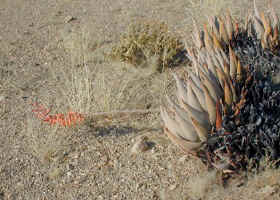
The smaller bright red Haemanthus coccinius (just behind the lilies photo above) is starting to open too.


Haemanthus coccinius. A month early for this lily but it might be the heavy rain shower we had in February that confused the lily. The flower is not fully open and smaller than it should be, but it is welcome all the same.


Four days later and the Haemanthus coccinius lilies are open. It is obvious why this lily is known as Paintbrush.

Saturday, March 10, 2007

This orchid Eulophia petersii which grows widespread in eastern Africa is very happy in the aloe garden. The plants are doing well under trees where they do not get or need any special attention. The relative small flowers look charming with the curling petals.
My mother got these orchids from a Fauna&Flora rescue expedition where a road would be built Natal. I did not take any plants as I always thought they would be difficult until about three years ago when I decided to give them a try.


The orchids bloomed in our garden for the first time December 2006, the same month my mother died. I spent 2 weeks with her and then 2-3 days after I returned I found the orchids hidden under the tree in full bloom. The first thing I thought was I have to phone Mom and tell her ... then I realized I can not phone her anymore.

Saturday, March 03, 2007

every drop countsWith the ongoing water shortage gardeners started to replace lawns with pebbles, gravel and crushed rocks. Some designs are remarkably eye-catching. Even where nothing more was done than to replace the lawn with pebbles, it looked pleasing in a calm way. It could be that it seems like that to me because I am aware that every drop of water saved counts, while the gardener just wanted something different to a lawn, but the end result is it saves water. Most of my life in Namibia saving water was part of life. Now saving water is starting to become the part of life in most cities all over the world.
I used to think it was difficult to keep gravel neat, but now I am surprised at how neat it remains. We have a gravel path on one side of the aloe garden for eight years now. The dust and small debris disappear under the gravel. We have never needed to rake as the gravel is open on all sides and the wind blows the leaves away.
A tip:- Nobody can walk quiet on gravel. Work the gravel into the garden's design to look pleasing but also as security on those sides of the house where it is needed.
Whatever the reason for the new designs in gardening, it opens a lot of possibilities for something different in the garden. Here are a few photos.


The lawn of the garden on the other side is just visible on the photo. Which garden looks better - with or without lawn is not the question. The point is that it is refreshing to see something different.


This garden used to have lawn all the way. That was somewhat dull.

Saturday, February 24, 2007

I got tagged by mediterranean garden spain, so I had to jump on the www and find out how this blog game is played.
It does not seem complicated:- tell 5 things that other bloggers do not know about yourself and tag 5 bloggers.
The 5 things are not quite so easy, I do not want to reveal personal secrets but I do not want to seem dull either.
1. After I married my first hobby was cutting and polishing semi precious stones. My husband soon got fed up that I spend too much time on it, so it did not last long - about 3 years.
2. My second hobby was aquariums (I had a fishbowl before I got married) I upgraded to a whole room full of aquariums and no amount of threats could get me off it until we retired. I wrote a book on aquariums, in the days of black and white.
3. I spent 13 years at home after marriage and that was no joke. I will rather work for a salary and pay somebody to clean the house. I am no good at housekeeping.
4. I like reading science fiction to relax. My favourite author is Izak Assimov and in contrast for my other self, I love to read Somerset Maugham and after I read them all, I start over. As I do not read fiction often, those authors last me years.
5. I am married to the same man for 40+ years (peleeze my age is a secret, that is near enough). I have never met a man with whom I even thought I would rather be married to.
I hope this is juicy enough. Now to get 5 bloggers !
Ps.
I got 5 bloggers but only these are still going strong.


Janet's Garden
gardening blog that I hope will be informative and useful

Mo garden
Gardening with Mo Gilmer


Saturday, February 10, 2007

green gardening love
We never thought much of Valentine day. Seems like one more way for people to make or spend money and love should be year round. However when I saw this old holiday photo today and I saw the heart at the end of the tunnel I decided to share it with all the garden and plant lovers.


May your love for gardening last forever.

And so say all of us.... 

Saturday, January 20, 2007

Rock wall garden

Usually a rock garden needs a lot of space, but this rock garden in the shape of a wall can be build in a very small area. There seems to be a shortage of planting space in any garden. Even if there is an open area then more often than not it will be in the wrong place.
If your hobby happens to be succulents then you can expand your hobby by building succulent plant walls in the relative small places like on a porch or patio against the wall or in the corner. In this situation it might be a good idea to use lightweight fake stones and a ready made small garden pond as base to catch the water and keep in the soil.

Rock garden against a wall

Hide an unsightly old wall by building a rock garden against the wall.


Or ----- build a rock wall

 in the backdoor garden mainly for the cliff hanging aloes. You might see a small portion of it in the left back corner on the last photo of the previous blog (thank you for water restrictions). It is behind the Aloe africana in bloom.
Here is how I built the wall. I have no doubt that most who do it will do it better but here is a rough idea to get you going.
Not counting hauling all those rocks - The rock garden wall was easy and relatively quick to build, while sitting on a folding chair. Rudi did not help (no need). I "use" him only when I must - and that is a lot.


The large heavy cement blocks do not need cement, just put them down. Use cement to keep the rocks in place on top of each other, unlike the normal rock garden where the rocks do not need cement as they are packed on and into a slope of ground. Leave a space between the building-blocks and the rock wall and leave some holes for the plants between the rocks. I found afterwards that if the wall was watered from the top, the soil spilled out of many of the planting holes. I stuffed the holes with paper which will decay in time and by that time the plants would have made enough roots to keep the soil from spilling out. Maybe if I had though of it I could have built the wall in "compartments" using paper as stoppers instead of the frustration afterwards to get the stoppers into the holes without damaging plants. It is also easier to fill the soil while building, than to try to force in soil into the small planting holes. blush... I should have thought of that while building.


The work scene. As you can see, it is easier with a little help and encouragement from a best friend. Watching between snoozes from the distance ( right side of photo).  Mix the size, colour and shape of the rocks. The wall must have a rough appearance, like a heap of rocks lying where they fell.


The succulent plants need to grow a lot more before the wall would be like I imagined it. It is nice to see the plants grow and find odd small succulents and small type aloes to stick in the holes.


The aloes on the top are Aloe hadyi. It is a cliff hanging aloe. Those leaves grow pointing down, they are not soft hanging down. If one of those aloes would be placed upright those leaves will stick out sideways. New leaves will change direction to grow down once more. I have seen that aloe grown from the watering hole underneath a hanging pot. It looks quite interesting. The flower inflorescens grows sideways for a short way, then it bends and grows upwards past the rest of the aloe plant still going downward.

This succulent rockwall garden is standing for 4-5 months. The cement is too clean and most plants must fill their space and some will be removed. I will keep you posted in another year.

It is not perfect yet, that is the ongoing challenge.
2014


Sunday, January 14, 2007

thank you for the water restrictions2004 was another dry year where the dams that supply water to towns in the Western Cape were running very low. One of the dams that supply both Cape Town and Moorreesburg were at a 15% low. Water restrictions were vital.
It was then that it finally dawned on us that we did not need a lawn. Especially not this small block of grass 9 metres x 10 metres with bare patches and holes dug by the dogs. I did not even take a photo of the lawn (or rather grass patch) as there is no need for me to be reminded of the frustration that went with it.


This was the first part of the transformation after we were sure all traces of grass were dead. We had to dig in compost and dolomite gravel as the soil was in poor condition. I love digging, pity there are always weeding to be done in the garden, seldom any digging. The photo was taken some time in January 2005.


This photo was taken June 2005 which is in winter and that is our rain season. The green moss growth can be seen on the path, right front of the photo. So far only the triangle middle back has been planted, but the other plants were growing fine and ready to be transplanted.
 It is not wise to replant aloes in wet conditions. The thick sap filled roots are brittle and break easy where rot can set in. There are three options at any time if the roots break; let them dry out before planting; cut them off completely (good idea as the roots will rot away or dry up in any case); or in dry conditions plant the aloes but do not water the aloe for at least 6 weeks. It is best to plant aloes when the new roots (they are bright yellow) start to show, at this stage they are not easily damaged. The roots of an aloe can be seen as expendable. The plant absorb the roots in bad times and regrow them very quickly in good times.


The photo above, of our backdoor garden December 2006, which is our summer. Two years after we started with the garden on the photo at the top. It was summer with few aloes in bloom. The Aloe africana was blooming out of season due to it being disturbed by transplanting such a large plant. It was transplanted by Rudi using his trusted method described in his blog resurrecting an aloe
The plants on the photo far left are all immature, they should make a better show in a few months time. I will show more details of the plants in the winter (June-July 2007)  follow this link below.
For more information on how this garden developed. 

Sunday, December 31, 2006

Summertime blooms with small differences
Summer is not the best time for flowers in our aloe garden, as most South African aloes bloom in winter. It is only the small area down here in the Western Cape where the winter rainfall aloes bloom in summer. It is logical coming to think of it, flowering in summer result in seeds ready for the rain in winter and the opposite holds true for the summer rainfall aloes. However rainfall in the dry desert areas of Namibia is the mainly in summer but the aloes will bloom before or after winter if there was good rainfall, shifting the flowering times to make the most of the rain. Then there are the tropical aloes which blooms at least twice a year and some hybrids bloom twice a year too. I understand there are some aloe cultivators who aim to develop a hybrid aloe which will bloom the whole year round like many of our cultivated garden flowers.
In short - it is possible to have at least one of the aloe species (or hybrids) in bloom at any time throughout the year. That does not mean changing the watering times will change the flowering times, nature tuned the plants finer than that. The plants have a daylight length timer and temperature timer as well. Having said that, it is possible to manipulate water, light and temperature including hormones, but not for the normal garden.
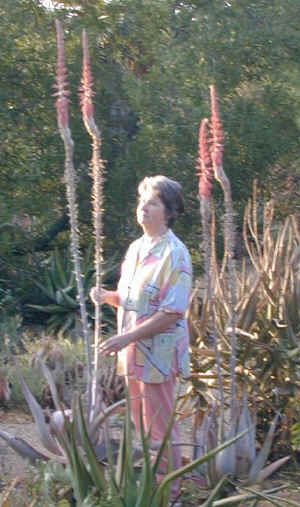
My favourite in our garden at this time is Aloe comosa the single stem plant can grow up to 5 metres with an inflorescens (flower stalk) that grows around 2 meters . The inflorescens keeps growing as the flowers open. Note the size of the plants (the two blue plants at my feet) in contrast to those long flower stalks. These plants were cultivated from seeds and it is their second year in bloom.


The habitat of Aloe comosa is just about 100 km north of Moorreesburg so we do not have any problem growing this aloe. A. comosa is a single trunk aloe. The flowers are a pastel peach-pink shading to cream as they open. The plant is a very pale blue-green shading to pink in the summer sun. At this time the rosette is very dry, it seems that there can not be any strength left to survive, but it will - provided nobody waters it. This aloe has adapted to no rain in summer.

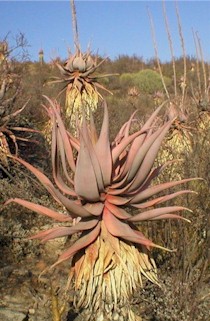
Aloe comosa in habitat. The stems alone are higher than I am - add to that the rosette and the very long inflorescens. It will be a long time for my plants to grow this size but that is not a problem as they bloom before they develop a stem.
By the way - This aloe makes a fine pot plant. As long as you can keep it out of the rain in summer. The contrast of the blue-pink rosette amongst other green plants makes an attractive display. Aloe comosa can withstand light frost.
 Photo above is aloe comosa left and aloe africana right.
The blooms of  Aloe comosa tip over from pointing upwards to hanging.  Aloe comosa has a raceme more than 2x the length of the Aloe africana raceme.  Aloe africana buds hang down right at the start and then the tips of each flower bends slightly upwards. The effect is completely different racemes.

Aloe africana is another lovely aloe blooming at this time in our garden. It should bloom July - September but it seems slightly confused by our climate. The habitat of Aloe africana is from the southern to the south eastern part of South Africa. It gets summer and winter rain, but before any-one from the rainy countries get excited, no frost.

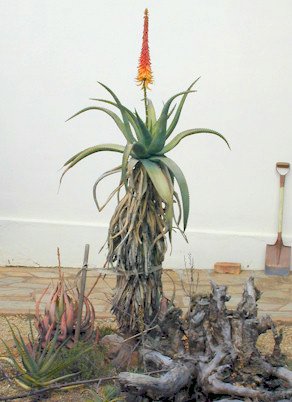
Photo  is Aloe africana and the spade is to show size. From the distance it looks like "just a typical aloe", but it is a good looking typical aloe and it has a  lovely infloroscens.


A habitat photo of Aloe africana does not show much. Everything is green and that is where this bright green aloe fits in. It is difficult to see on a photo but the whole hill is covered in Aloe africana unfortunately not in bloom at the time. Pity, but imagine it.


Below are the close-up photos of the flowers of Aloe comosa and Aloe africana. Aloe comosa has a raceme more than 2x the length of the Aloe africana raceme. The A.comosa buds point upwards then they tip over to hang pointing down in the end. Aloe africana buds tips over right at the start and then the tips of each flower bends slightly upwards. The effect is completely different racemes.


Saturday, December 23, 2006

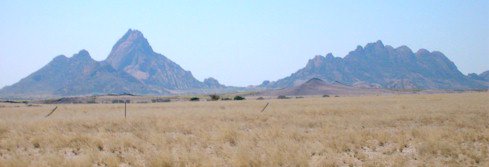
The Spitzkoppe an enchanted very harsh world of beauty and horror tales of murder. Crystals gems played a role but there are also rare plants, insects and  animals - all attracted adventurers through the ages.


Heading back to Windhoek from Henties Bay. Those are not just any hills up front. Pass them, then turn off into a smaller dusty road where only donkey carts and 4-wheel driven vehicles can go and enter a wonderland of gemstones. We were there once many years ago. It was a weird feeling to have to watch your step not to trample on a gemstone.
Please note. I do not suggest that you go there without the necessary permission. The minerals belong to the person/persons who have a mining claim on it. The area is guarded by the Damara people on who's ground it is.


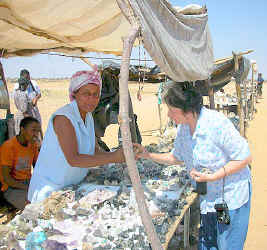
I find the natural beauty of crystals dazzling, more so than a cut precious stone. In these informal stalls along the roadside near Usakos, stones are sold way cheaper than in any of the many shops that sell the mineral crystals, gemstones and semi-precious gemstones in Namibia. Gemstones and crystals have been traded for centuries although not on the scale as the last decades.
These informal traders know their stones. Not only the common names but also the scientific names and some geological information too.
It is difficult to resist "all that glitters" - but that is another blog.

Sunday, November 26, 2006

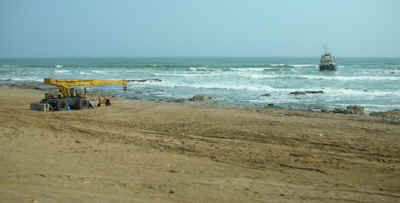
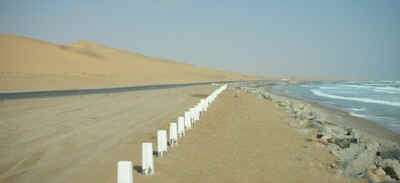
Aloe asperifolia and the salt road along west coast Namibia.  We are on our way to see the desert aloe Aloe asperifolia. Driving along the salt road to Swakopmund and on to Walvis bay where we saw a large crane trying to pull out a stranded fishing boat.
As to the salt road. It is really made of the salt from the salt pans which are plentiful along the west coast. The gypsum, which is one of the components in the salt binds with the sand, the salt as such helps to catch the water from the fog that keeps the mix from drying out and form a hard crust. It is a good road to travel on, like a tar road. This road can not exist where it rains or where the air is dry.
We traveled from Windhoek to Karibib, visited the cemetery at Usakos and took the turn-off into the dust road. That took us to Henties bay, from there along the salt road to Swakopmund and tar road to Walvis bay


Karibib - can you believe that quiet street? I am standing in the main road taking this photo. This is the main road down to the coast, so there are often cars travelling through and some people on the main road at the few shops. There is one shop that we do not pass when we are in Karibib and that one sells gemstones and rock crystals. It looks like nothing from the outside, but inside it is huge with the things that glitter which stops a woman's heart. sighhhh


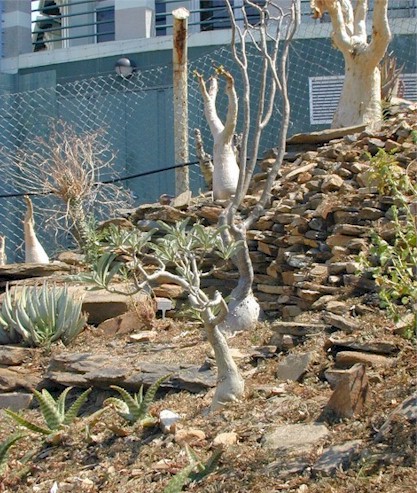
 I need some information here regarding the photo (above).  Please take a close look.  The large obvious plant without leaves is a Cyphostemm species, I want information on the plant with the thin branches next to the Cyphostemma. The plant with the thin long greyish branches and pretty seedpods which look like wings of a bird flying. Those pods are large. One pod is nearly the length of my hand.  In the background is the Karibib police station.


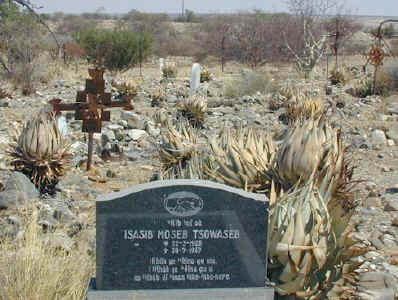
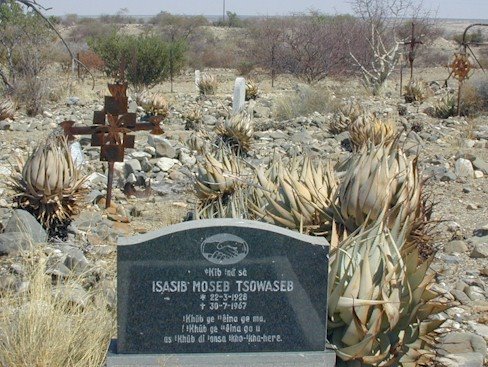
At Usakos the plants were dry with no sign of the wide spread rain that fell in the rest of the country. The Aloe hereroensis in the old cemetery were not in flower like Aloe hereroensis in the southern areas of Namibia. Some of the aloes showed a faint green coloring in the center of the rosette assuring me that these aloes are tough, they will survive.
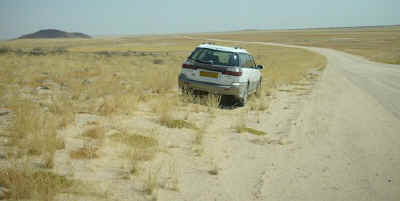


The dust road to Hanties bay. The grass fields in the desert are unbelieveable !  We never saw so much grass in the desert before. The local habitants (mainly small animals and insects) did not experrience this in a century.
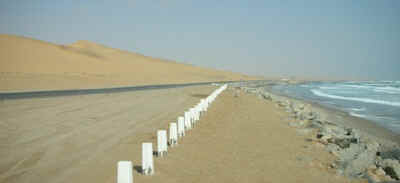


The main road between Swakopmund and Walvis bay. Lovely picturesque dunes.
Below:- The crane pulling the fishing boat out of the sea. The fishing boat is past the point of seafaring ever again, it will be sold as scrap.


Imagine what it would have been like centuries ago to land on this shore. Nothing but large dunes. Not altogether so bad as the mouth of the Swakop river is less than 5 kilometres away. Skeleton Coast starts to the north, but anybody shipwrecked would not be able to get far without water on this coast, even if they are not yet in the skeleton coast area.
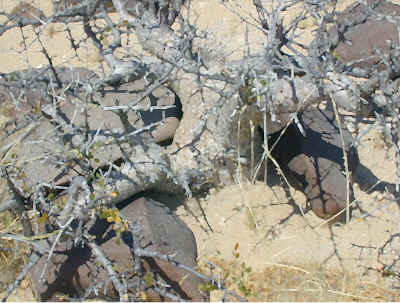


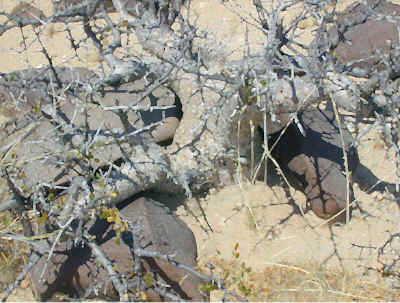
One of the trees adapted to the life in the desert. The branches are not higher than 40 cm at the most and the diameter of the tree with all branches included is not quite 2 m. but the tree is actually larger as the main stem is underground like a huge water reservoir.
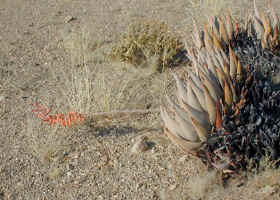


Aloe asperifolia can survive the desert habitat very well. The plants are in excellent condition with the pale green plants showing new growth. The thick leaves are full of moisture which are absorbed dew or fog from the sea-air.
Most plants have bloomed out. The single raceme with flowers that we saw was very small and not much to look at. It happens that aloes send out a sub-standard raceme after it bloomed. It shows the typical sideway growth of the inflorescens.

Sunday, November 19, 2006

Windhoek Namibia

aloe littoralis the pride of Windhoek Namibia. Aloe littoralis is on the emblem of Windhoek city. Aloe littoralis is a tall tree aloe hardy from below freezing to sizzling summer temperatures. The outstanding point about Aloe littoralis for the garden is that it blooms from a young age.
Windhoek is the capital city of Namibia. This neat clean city without smog, is situated between mountains on an uneven hilly terrain. Wild animals like the Kudu, jackal and different small mongooses can be seen in the hills around the city, especially in times of drought.


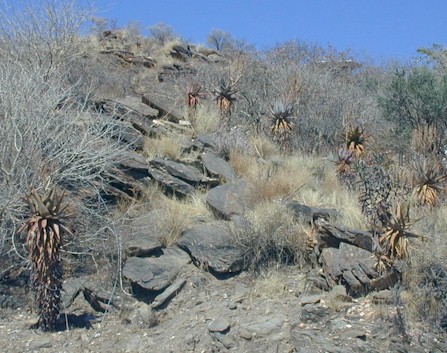
The habitat of Aloe littoralis is North- western  Province of South Africa, all the way up through Namibia up to Angola, to the east into Botswana and a short distance into the northern Province of South Africa. Photo below shows the dry winter scene in Namiba. Aloe littoralis blooms early winter before frost can damage the blooms and seeds.


A visit to the botanical garden in Windhoek is certainly worth the effort for succulent plant enthusiasts and anybody who would enjoy to see the endemic trees and rare plants of Namibia. The botanical garden covers a large area over the hill with walking trails.


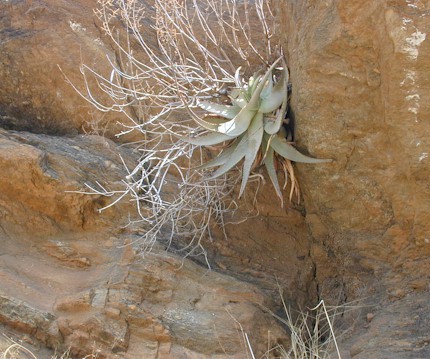
Aloe dewinterii planted in the botanical garden the same way as it grows in the natural habitat - hanging from cliffs.

Windhoek.
The baboons tend to be a dangerous nuisance. They are cute to look at, but they can attack and the males are large enough to kill a human or dog. The photo below is from a large handsome male who saw the ripe papaw in the garden and decided that it was just what he wanted. We did not want to agitate him so we took the photo through the kitchen window. This gives the impression that he is behind bars, but we were strictly speaking behind the bars not him.


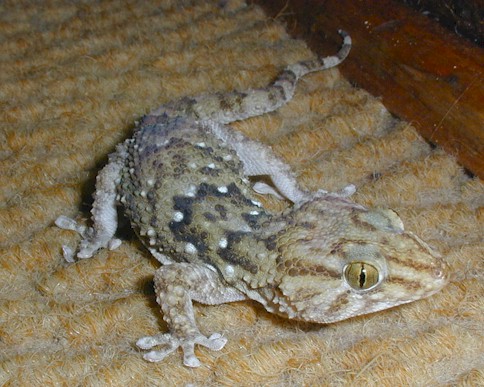
The wild life in and around Windhoek includes many cute animal like this gecko.


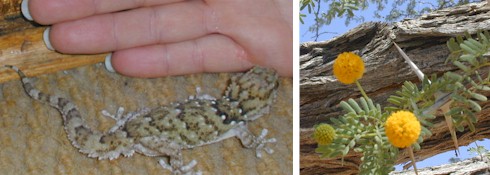
Gorgeous little fellow. Those large eyes are handy for his nightlife adventures. He can run on the ceiling by tiny slits under his feet that form a suction on the substrate. His feet feel like velvet if he is on your hand. I do hope the old tale that they are poisonous has been cleared in modern times. He will hiss to try and defend himself and his bite feels like a soft pinch. It does not even leave a red mark, far from drawing blood, let alone the ridiculous poison tale.  My guess is the hissing reminded people of a snake and from there the poisonous tale.


The little gecko will run if he is on a wall but on this carpet he thinks that he will disappear like when he is on the bark of a tree, so he remains still. This works out fine in nature on a camelthorn tree but at night on a carpet some-one will step on him. Consequently any gecko on the carpet, no matter how cute he looks, is put outside.

Friday, October 06, 2006

Aloe dichotoma and Aloe hereroensis in the southern Namibia. All endemic aloes are strictly protected in Namibia.
Namibia has only 2 seasons, a long hot summer and a short cold winter. It is now September which should be spring, but here that is no option. The dry heat is not as depressing as humid heat of tropical countries, but the hot day temperatures reach dangerous levels in the sun.
Namibia has 27 endemic aloe species. The habitat of some of these aloe species go over the borders into the neighbouring countries as plants do not grow inside political borders, but there are aloe species with a very small habitat inside Namibia only.
This was not a tour to see all the aloes of Namibia, but a quick trip up to Windhoek with a day trip to Swakopmund visiting family. It is a pity that time was short.


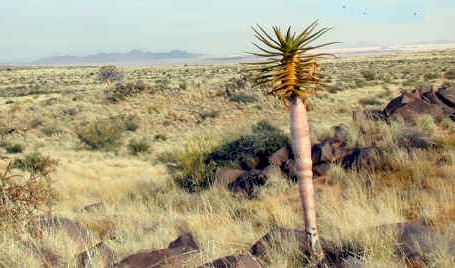
The dry semi-desert southern part of Namibia is the habitat of Aloe dichotoma.
It was exhilarating to find such a healthy young Aloe dichotoma tree. Very few seeds reach this stage. The photo below shows an old tree with dead branches - battle scars dealt out by nature.


An Aloe dichotoma garden with pelargoniums and mesembs at a petrol garage with Bed&Breakfast bungalows at the small town, Gruenau. It was a pleasant surprise to find the petunias in bloom protected by some reeds on the other side of the Aloe dichotoma garden. The dry hot day temperatures scorch anything that is green and yet here are these fragile flowers growing happily.


The distance from the border to Gruenau is 120 kilometres and to the next town Keetmanshoop is 146 kilometres. Few tourists do not stop for petrol here, which is just fine for al concerned in this lonely location. (petrol = gas in the USA)

Informal shops catering for tourists, at the roadside opposite the Bed&Breakfast. Never be out in the midday sun over here. Note the barren mountains in the background.


The elephant is astonishingly realistic. I hope that the pile of hardwood for sale as well as the carved animals and figurines are from dead trees. Namibia has a very low supply of hardwood trees. The Camelthorn tree is very hardy but in a harsh climate it grows slowly.
The seedpods and seeds of most Acacia trees are edible and used as fodder for farm animals. (The wild herbivores appreciates it too). We saw many small stalls alongside the roads where people were selling bags of Acacia pods in the central parts of Namibia.


There are a few very special and rare aloes in the southern regions of Namibia. We did not have time to drive out to Aus but I would like to mention Aloe pachygaster. I took some photos of this aloe in the botanical garden in Windhoek.
Aloe pachygaster grows in the most harsh conditions in Namibia. Aus is the coldest place in this country with freezing winters, even snow. This should be good news to aloe enthusiasts in the cold countries. There is no need to bring Aloe pachygaster inside in winter but keep this aloe out of rain all year round. Water it sparingly in autumn only.
for more photos and tips see my web site


Aloe hereoensis in bloom a few kilometers past Keetmanshoop on the way to Mariental.

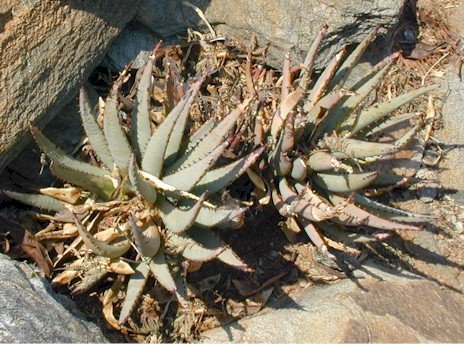
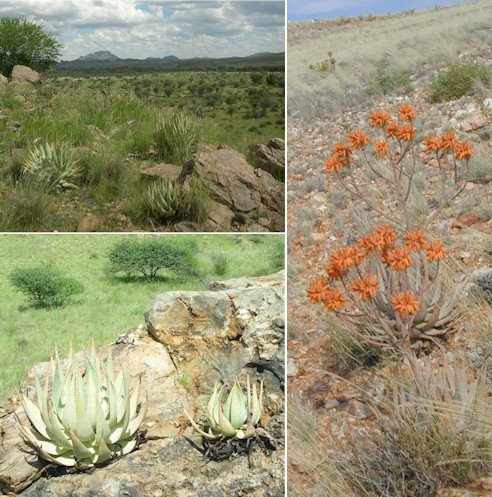
Aloe hereroensis has a wide distribution throughout Namibia to the neighbouring countries. Photos below left were taken during the good rains in the beginning of the year 2006. Photo right were taken in September 2006 - the aloe plants are in bloom and the grass so green on the photo left are now dry with the seeds blown away by the wind.


Aloe hereroensis in the old cemetery of Usakos. We expected them to be in flower, but although they showed some new growth, the rain was obviously not enough.